The Communist Manifesto: Before It Was Famous; The Manifesto of the Communist Party - A Volume Containing the Text as It Evolved
RELEASE DATE
12-16-25
LENGTH
2 hrs and 5 mins
A groundbreaking historical edition of one of the most influential documents of the modern age—restored, clarified, and presented as it first evolved.
This is not another reprint. This is the Manifesto before it became famous.
The Communist Manifesto: Before It Was Famous brings together, for the first time in one volume, three complete historical versions of the text that shaped debates on labor, industry, and social change across the 19th and 20th centuries. This edition is designed not for ideological arguments, but for listeners who want to understand how the Manifesto actually developed—linguistically, politically, and historically—from its first appearance in 1848 to its later English interpretations.
What This Volume Contains
The 1888 Authorized English Translation, revised and clarified by Friedrich Engels.
The 1898 American Printing, a rare facsimile from the early socialist movement in the United States.
The Original 1848 German Pamphlet, reproduced as the twenty-four–page document that ignited a century of debate.
Presented in this order, the listener can experience the Manifesto change in tone, emphasis, and styleas it traveled through different audiences and political climates. The result is a unique archival experience that allows modern listeners to see the text as its original readers saw it.
A Book of Living Proverbs
WRITTEN & NARRATED BY
RELEASE DATE
12-30-25
LENGTH
1 hr and 23 mins
A book of living proverbs is a modern scripture in miniature—an illuminated journey through judgment, mercy, failure, and the quiet revelations that shape a life.
In this original work, dennis logan revives the ancient voice of wisdom literature, weaving new parables and moral scenes in the timeless style of kings and prophets. Each proverb is paired with a striking woodcut-inspired illustration, forming a contemplative cycle that feels both newly discovered and centuries old.
Through the eyes of solomon and the silent witness of his royal recorder, these living proverbs explore:
• the hidden cost of pride
• the weight of leadership
• betrayal and forgiveness
• envy, ambition, and the search for meaning
• the difference between judgment and understanding
• the way small acts bend the course of a greater destiny
Listeners will encounter households divided, warriors in conflict, merchants tempted by deceit, fathers and sons reconciled, and a weary king who learns that wisdom is not a throne but a pilgrimage.
Blending poetic storytelling with the solemn beauty of black-and-white engravings, a book of living proverbs invites reflection, conversation, and repeated return. It is a book to sit with, to turn slowly, and to share—one that honors the past while speaking powerfully to the present.
For seekers, teachers, parents, and anyone walking the long road of becoming, this volume offers a lantern’s worth of clarity: simple scenes filled with deep, resonant truth.
The Madman: His Parables and Poems
RELEASE DATE
01-05-26
LENGTH
46 mins
Step into the profound and mystical world of The Madman, where Khalil Gibran, one of the greatest philosophical poets of the 20th century, takes you on an introspective journey. With Dennis Logan's captivating voice, this audiobook brings Gibran's timeless parables and poems to life like never before. Known for his powerful delivery, Dennis Logan adds depth and emotion to each passage, perfectly capturing the spirit of the text.
In this collection, Gibran explores the paradoxes of life, freedom, and the nature of the self. The Madman invites you to reflect on profound truths hidden within simple tales, challenging conventional wisdom and inspiring inner awakening. With each parable, Logan’s narration draws you deeper into Gibran's visionary mind, creating an immersive listening experience that will resonate with both your heart and intellect.
Whether you're seeking spiritual insight, a fresh perspective on life's mysteries, or simply a beautifully narrated audiobook, The Madman is a must-have. Let the eloquence of Gibran’s words and the richness of Logan's voice transport you into a world of wisdom and inspiration.
Perfect for lovers of philosophy, spirituality, and classic literature, this audiobook offers a timeless experience that you'll want to revisit time and time again.
Miracle Mongers and Their Methods: A Chronicle of Wonder, Deception and Early Skepticism
RELEASE DATE
01-07-26
LENGTH
6 hrs and 33 mins
Harry Houdini’s Miracle Mongers and Their Methods is an early investigation into scams, spiritual fraud, stage magic, and belief manipulation—documenting how miracle workers, psychic mediums, and faith healers exploited public fascination with the supernatural. Written before the age of social media and viral deception, the book reveals patterns of belief and persuasion that continue to shape modern conspiracy culture and online spectacle.
This modern audiobook edition presents Miracle Mongers as a work of cultural history rather than a technical exposé. Houdini’s skepticism and investigative rigor are preserved, while the performers he examines are understood as reflections of enduring psychological and social patterns—belief, persuasion, charisma, and the longing to witness the impossible.
The recording is structured as a book within a book and features two narrators. Dennis Logan provides the contextual framework, introduction, commentary, and closing reflections, placing Houdini’s work within the history of scientific inquiry, early investigative journalism, psychology of belief, and skepticism. The core text of Miracle Mongers and Their Methods is narrated by Joseon Hong, allowing Houdini’s original voice to stand on its own as a primary historical document.
Together, these layers connect Houdini’s world to contemporary phenomena such as viral spectacles, extreme stunts, modern scams, conspiracy culture, and digital belief economies. Whether approached as a study of magic and illusion, an early work of skeptical inquiry, or an exploration of why people believe what they believe, this edition invites listeners to step behind the curtain—and examine why the miracle mangers Houdini exposed still find willing audiences today.
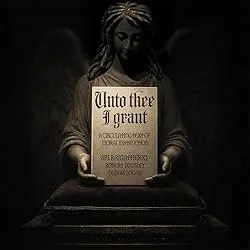
Unto Thee I Grant: A Circulating Text of Moral Instruction
RELEASE DATE
01-29-26
LENGTH
3 hrs and 37 mins
First issued in 1925, Unto Thee I Grant is a concise work of ethical instruction composed in aphoristic form. Designed for reflection rather than doctrine, it belongs to a long tradition of moral literature intended to be read, remembered, and applied across contexts.
This edition presents a faithful photographic facsimile of the Fifth Printing published in December 1930, preserving the original typography, layout, and structure. The text is reproduced without modernization or interpretive revision, allowing listeners to encounter the work as it circulated in the early twentieth century.
Beyond the primary text, this volume includes carefully prepared editorial materials that situate Unto Thee I Grant within the broader history of moral and spiritual literature. These essays document how ethical texts have historically been transmitted, reframed, and repurposed across publishing environments, fraternal organizations, and religious movements. The focus is descriptive rather than doctrinal, emphasizing provenance, genre, and circulation over belief or advocacy.
Also included are supplemental reference materials addressing common patterns in the formation of sacred and quasi-sacred texts, along with a practical framework for reading scripture and moral instruction as historical artifacts. These tools are intended to support religious literacy, comparative reading, and informed engagement with foundational texts.
This edition neither promotes nor critiques any particular belief system. It offers Unto Thee I Grant as it originally functioned: a circulating work of moral instruction whose language proved durable precisely because it was adaptable. Listeners interested in ethics, philosophy, religious history, and the transmission of spiritual literature will find this volume a clear and grounded point of reference.
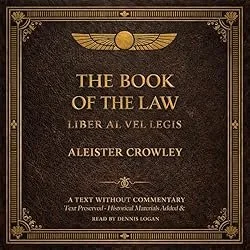
Liber AL vel Legis [The Book of the Law] A Text Without Commentary
RELEASE DATE
01-08-26
LENGTH
1 hr and 4 mins
The Book of the Law (Liber AL vel Legis) is one of the most influential and controversial spiritual texts of the modern era. First received in Cairo in 1904, it has shaped movements, inspired artists, unsettled institutions, and resisted explanation for more than a century.
This edition presents the text without commentary.
The core work appears here exactly as transmitted, without annotation, interpretation, or doctrinal guidance. No effort is made to explain the verses or resolve their meaning. The text stands alone.
Following the text, this volume provides a substantial historical record documenting how Liber AL vel Legis entered the world, how it circulated, and how it came to occupy a unique position within twentieth- and twenty-first-century culture. These materials address the people, organizations, controversies, and cultural afterlives surrounding the book, including its relationship to Thelema, the Ordo Templi Orientis (OTO), and the broader Western esoteric tradition.
This edition also traces the reception and reintroduction of The Book of the Law across generations, from early manuscript circulation and institutional resistance to its influence on literature, music, counterculture, and contemporary art. Rather than interpreting the text, it documents its persistence.
Prepared as a preservation edition, this volume separates primary text from historical context with clarity and restraint. It is intended for listeners who want direct access to Liber AL vel Legis as a primary document, alongside an honest account of its transmission and impact, without mediation.
More than 120 years after its reception, The Book of the Law remains unresolved, contested, and continuously rediscovered. This edition preserves that condition.
The Space-Born: A Poetic Meditation on the Infinite

RELEASE DATE
02-04-26
LENGTH
1 hr and 5 mins
The Space-Born is a rare poetic work by Manly P. Hall, presented here as a complete cycle of meditative poems reflecting on human consciousness and its relationship to the infinite.
Best known for monumental works such as The Secret Teachings of All Ages and Initiates of the Flame, Hall adopts a quieter and more interior voice in this volume. These poems do not teach through argument or exposition, but through image, rhythm, and reflective cadence. Together, they form a contemplative sequence concerned with inner awakening, moral responsibility, and the meeting point between spirit and lived experience.
This audiobook is narrated by Dennis Logan, whose steady, unhurried delivery has become a familiar presence to listeners of enduring philosophical and spiritual texts. His voice is well suited to the character of The Space-Born, allowing the poems to unfold naturally, without emphasis or intrusion.
The poems are presented without commentary, inviting return rather than resolution. While often approached as a work for meditation and reflection, many listeners find its measured language and gentle pacing especially conducive to quiet hours, when thought slows and attention softens.
Based on a facsimile of a 1930 first edition source, this edition preserves minor material imperfections as marks of provenance, while rendering the text with clarity for listening.
The Space-Born stands alongside Hall’s more widely known works as a companion rather than a counterpart: not a book of answers, but one of orientation, written for those who understand that the most enduring wisdom speaks softly, and reveals itself over time.
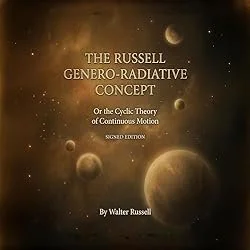
The Russell Genero-Radiative Concept or The Cyclic Theory of Continuous Motion
RELEASE DATE
03-10-26
LENGTH
4 hrs and 28 mins
Originally published in 1926, The Russell Genero-Radiative Concept is a concise and provocative exposition of Walter Russell’s cyclic theory of continuous motion. In this rare work, Russell outlines a universe governed not by linear mechanics, but by rhythmic balance—where all matter, energy, and motion arise from the interplay of generative and radiative forces.
Russell proposes that creation and dissolution are not opposing events, but complementary expressions of a single universal principle. Matter is formed through centripetal, generative motion and returned to equilibrium through centrifugal, radiative motion. From atomic structure to stellar systems, Russell presents a unified cosmology in which motion is continuous, self-regulating, and inherently ordered.
This facsimile edition faithfully reproduces the original historical text, preserving the author’s language, structure, and diagrams exactly as first published. It is intended for listeners seeking direct access to Russell’s original ideas without modernization, interpretation, or abridgment.
The Russell Genero-Radiative Concept is not a textbook of conventional physics. It is a philosophical and cosmological work that challenges materialist assumptions and invites the listener to reconsider the nature of energy, electricity, gravitation, and universal balance. As such, it holds enduring interest for students of metaphysical science, cosmology, sacred geometry, alternative physics, and the history of speculative thought.
This volume is ideal for collectors, researchers, and serious people who wish to study Walter Russell’s system as it was originally presented—unfiltered and intact.
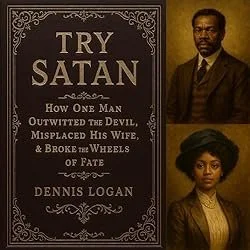
Try Satan: How One Man Outwitted the Devil, Misplaced His Wife, & Broke the Wheels of Fate
WRITTEN & NARRATED BY
RELEASE DATE
03-25-26
LENGTH
1 hr and 7 mins
If faith may be tested, why not test the Devil as well?
That question begins the strange confession of Elijah Booker.
Presented as a recovered manuscript, Try Satan follows the reflections of a man who decided to run an experiment most people would never dare attempt. What begins as a simple challenge to the unseen quickly opens a door into a world where belief, ambition, and power move through society in ways few people ever see.
As Elijah’s life begins to shift in ways both fortunate and deeply unsettling, he starts to glimpse the hidden patterns beneath everyday success and failure. The rules of the world begin to look less like destiny and more like design. Once a man sees the mechanism at work behind the curtain, he cannot easily pretend it isn’t there.
Blending African American literature, pulp fiction, religious fiction, supernatural drama, and philosophical storytelling, Try Satan delivers a dark, thought-provoking narrative filled with strange encounters, unsettling insights, and dangerous ideas.
Part confession, part metaphysical thriller, and part spiritual provocation, this audiobook invites listeners into a story that challenges comfortable assumptions about faith, power, and human nature.
Because sometimes the most dangerous experiment is not believing in the Devil.
It’s deciding to test him.
The Gospel of Nicodemus, the Acts of Pilate, and the Harrowing of Hell
By Joseph Lumpkin | Narration by Dennis Logan
Run Time: 6 hours and 46 minutes
Release Date: November 12, 2024
In early Christianity, a diverse body of texts emerged alongside the canonical scriptures, many of which aimed to fill in gaps left by the New Testament narratives. Among these apocryphal works, the Gospel of Nicodemus, which includes the Acts of Pilate and the account of the Harrowing of Hell, stands out for its rich portrayal of the events surrounding Christ's trial, crucifixion, and descent into Hell. These texts, though non-canonical, offer a unique glimpse into early Christian beliefs and the theological debates that shaped the development of the faith.
The Gospel of Nicodemus provides an expanded account of Christ's interaction with Pontius Pilate, a figure central to the passion narrative. This work, closely associated with the Acts of Pilate, portrays Pilate in a more sympathetic light than the canonical Gospels, reflecting early Christian apologetic efforts to legitimize Christianity in the Roman Empire. The Harrowing of Hell, a key section of the text, explores Christ’s descent into the underworld after his crucifixion—a theme that would have profound theological implications for the doctrine of salvation and the afterlife in both Eastern and Western Christianity.
The Samaritan Pentateuch - A History and Study Guide
By Joseph Lumpkin | Narration by Dennis Logan
Run Time: 6 hours & 15 minutes
Release Date: November 25 2024
The similarities the Samaritan Pentateuch (SP) shares with the Dead Sea Scrolls (DSS), as well as many similarities with the Septuagint (LXX), challenge the longstanding view that the Samaritan Pentateuch is a later, borrowed, and altered form of the Masoretic Text (MT). The historical devaluation of the Samaritan Pentateuch requires reevaluation, based upon the contextual cohesiveness of the Samaritan Pentateuch, agreement with the most ancient texts of the DSS and LXX, and the uninterrupted and non-dispersed oral transmission of the Ancient Israelite Samaritans.
The Samaritans claim their Torah is older and more authentic. They lived in one place for thousands of years and kept their Torah preserved.
The Israelite Samaritan people are one of the most ancient indigenous people, continuously living in the Middle East, counting their ancestry back to over 125 generations. The religious customs of the Israelite Samaritans have remained relatively constant for thousands of years. Their transmission of the Torah has been uninterrupted.
In the winter of 1947, a group of archeological specialists searching through 11 caves in Qumran happened upon the Dead Sea Scrolls. After rigorous study of the scrolls, researchers have come to believe there were several versions of the Torah being studied throughout Jewish history, according to Eugene Ulrich, a theology professor at the University of Notre Dame.
“Finding the Dead Sea Scrolls proved that there were two versions, if not more, of the Torah circulating within Judaism, but they were all dealt with equal validity and respect,” said Ulrich, who served as one of the chief editors on the Dead Sea Scrolls International Publication Project. “The Samaritan Torah and Masoretic Torah used to be studied side by side. The Masoretic text wasn’t always the authoritative version. They were both seen as important during the Second Temple time period.”
The Secret Gospel of Mark
By Joseph Lumpkin | Narration by Dennis Logan
Run Time: 2 hours & 56 minutes
Release Date: December 12 2024
Did Christianity begin as a mystery cult led by a man named Jesus? Did the initiation ritual contain mysterious ceremonies that only Jesus could perform? Who was the young man in the Gospel of Mark wearing nothing more than a sheet? Why was he there? Was he about to undergo the rites and rituals of initiation into the Jesus cult, or was he simply there to be baptized into the faith? Are there other “Gospels of Mark” out there? What do they say about Jesus, his life, death, and resurrection?
In 1958, Morton Smith, a professor of ancient history at Columbia University, found a previously unknown letter of Clement of Alexandria in the monastery of Mar Saba situated 20 kilometers (12 miles) south-east of Jerusalem. The letter from Clement mentioned an unknown Gospel called The Secret Gospel of Mark. Its contents would start a firestorm among scholars and academics.
You are about to venture into the twisting, turning world of discovery, history, and allegations, as scholars battle to decide what this discovery means and what its place could be in the history of the faith.
The Epistles of Ignatius, Containing the Epistles to Ephesus, Magnesia, Tralles, Rome, Philadelphia, Smyrna, and Polycarp
By Joseph Lumpkin | Narration by Dennis Logan
Run Time: 1 hour 46 minutes
Release Date: December 18 2024
“When a man knows he is to be hanged in a fortnight, it concentrates his mind wonderfully.” In Samuel Johnson's famous quote, "When a man knows he is to be hanged in a fortnight, it concentrates his mind wonderfully," we find a sobering observation about the power of impending death to focus one's thoughts. Thus is was for the mind and spirit of this soon-to-be martyr. He writes:"Allow me to be an imitator of the passion of my God." (Letter to the Romans, 6:3)In his letters, Ignatius refers to his journey to Rome as divinely ordained, believing God has chosen the time and mean of his death. Thus, he believes his death will serve as a witness to his faith as well as a source of inspiration for the Christian community. As he travelled in chains to Rome, he wrote letters to the churches, pouring out his heart to them and instructing Christians in faith and exhortations. While they were in Smyrna, Ignatius went to see Polycarp (60–155 CE), an old friend of his who was now the Bishop of Smyrna. Deputies from the churches at Ephesus, Magnesia, and Tralles came to see Ignatius, and it was at Smyrna that Ignatius began to write his series of epistles to the Christian churches in different cities. In Smyrna, he wrote letters to the Ephesians, the Magnesians, and the Trallesians, exhorting them to obey their bishops, avoid heresies, and keep the faith. The group left Smyrna by boat to Troas, where Ignatius wrote three more epistles to the Philadelphians, to the Smyrnans, and finally one to Polycarp. He wanted to address the multitudes in Troas, but the guards were refused and took him to Rome to face his death. There, he was torn apart by wild beasts as thousands looked on and cheered.These are the letters of Ignatius. He was full of faith and eager to prove it to God and his fellow Christians.